№ 14 · PERIODONTOLOGY
Why gums bleed — and when it becomes dangerous
June 06, 2026 · QDRO
Blood on your toothbrush is not a sign that you are brushing too hard. It is a warning signal — one that most people dismiss for years. Studies show that 52.9% of patients notice gum bleeding during brushing, yet fewer than half of them consider it a pathology. The rest attribute it to a stiff bristle, a bad technique, or simply "normal for me." Meanwhile, the painless inflammation quietly destroys bone. By 2021, more than one billion people worldwide were living with severe periodontitis.
What happens inside the gingival sulcus
Between each tooth and the surrounding gum lies a narrow crevice — the gingival sulcus — normally 1 to 3 mm deep. This is where dental plaque accumulates: a structured biofilm of several hundred bacterial species, including gram-negative anaerobes such as Porphyromonas gingivalis, Tannerella forsythia, and Treponema denticola. These organisms are not passive residents. They actively evade immune clearance and release enzymes — gingipains, lipopolysaccharides — that disrupt host tissue.
When plaque builds up, the epithelial cells lining the sulcus detect bacterial patterns and trigger an inflammatory cascade: IL-1β, IL-6, and TNF-α are released, vessels dilate, and vascular permeability increases. The sulcular epithelium thins to just one or two cell layers. At that point, even gentle mechanical contact — a toothbrush, a strand of floss — is enough to cause bleeding.
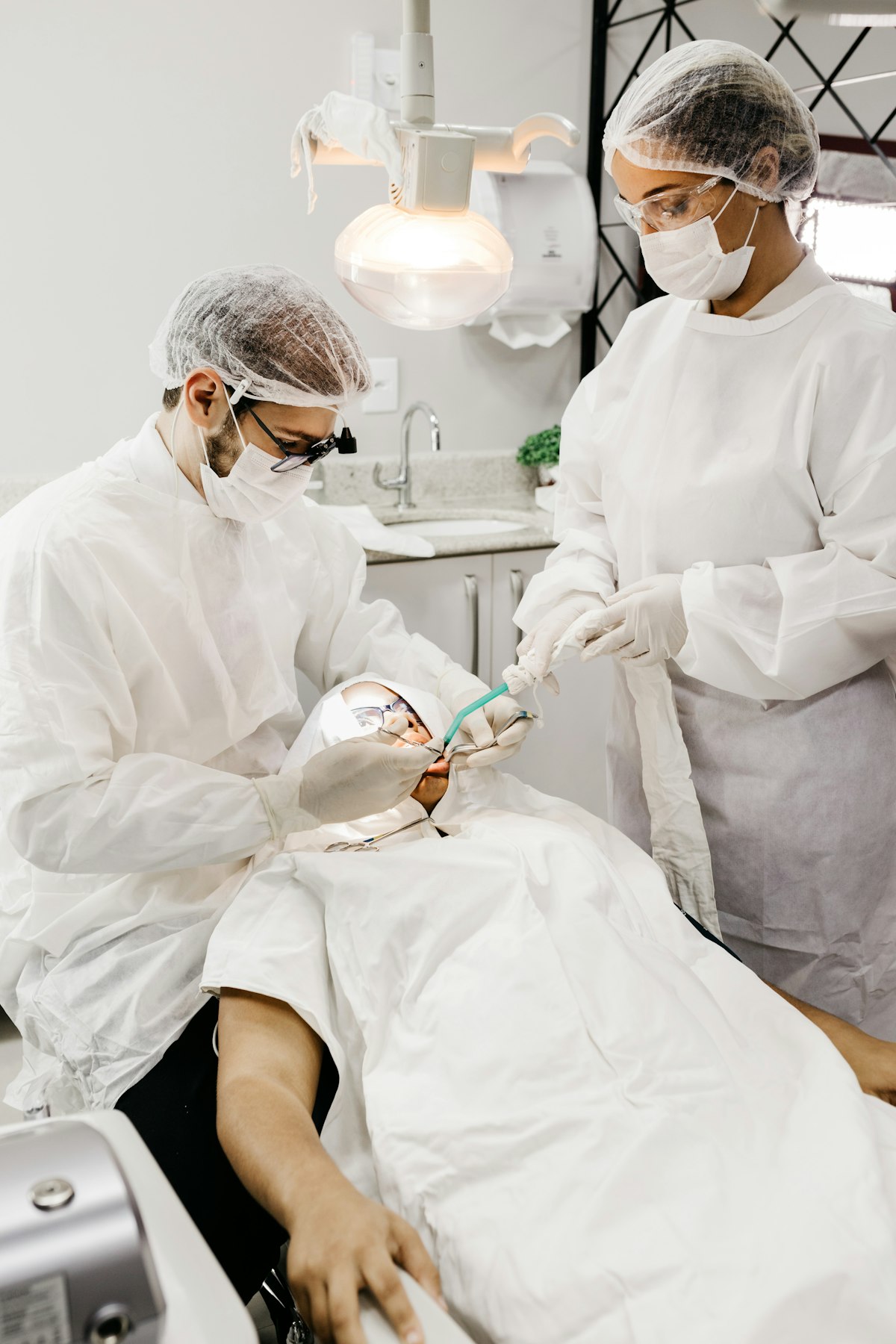
At the gingivitis stage, inflammation is confined to the soft tissues. The bone is untouched. This is clinically important: gingivitis is fully reversible if the cause — bacterial plaque — is removed. But if inflammation persists for months, it activates the RANKL pathway. Inflammatory mediators stimulate osteoclasts, which begin resorbing alveolar bone. This is periodontitis, and the bone lost at this stage does not grow back spontaneously.
There is a second process that went largely unrecognised for decades. Bacteria and their products — particularly P. gingivalis gingipains — can translocate into the systemic circulation through the inflamed epithelium. This sustains chronic low-grade systemic inflammation, a mechanism now being studied in the context of atherosclerosis, type 2 diabetes, and neurodegeneration.
What the data actually show
A 2022 analysis in the Journal of Clinical Periodontology (PMID 34494292) examined self-reported gum bleeding on brushing as a diagnostic marker. The sensitivity of patient-reported bleeding was 37.1% for periodontitis and 61.3% for gingivitis, with specificities of 84.8% and 84.4% respectively. In plain terms: most people who have gum inflammation either do not notice bleeding, or do not flag it as a symptom. Those who do notice it are usually right — the specificity is high. But bleeding is not a sensitive alarm; its absence does not guarantee health.
The median bleeding on probing (BOP) score among patients who reported gum bleeding during brushing was 25.0%, compared with 13.5% among those who did not. Under the 2018 periodontal classification, a BOP above 30% marks generalised gingivitis.
The scale of the problem is captured in the Global Burden of Disease 2021 data (PMC12125741). Severe periodontitis affected 1.07 billion people in 2021. The number of new incident cases grew 76% between 1990 and 2021 — from 50.8 million to 89.6 million per year. The peak age group is 50–59, but the disease starts early: among 12-year-olds in China's Guangdong province, localised gingivitis was found in 21.8% and generalised gingivitis in 5.4% of children (PMC9768968).
The cardiovascular connection is no longer a hypothesis. A 2023 meta-analysis of 39 prospective cohort studies including 4,389,263 individuals (Journal of Periodontal Research, PMID 37682950) found that periodontitis was associated with a 24% higher risk of major adverse cardiovascular events (RR 1.24; 95% CI 1.15–1.34), a 26% higher stroke risk, a 42% higher cardiac mortality risk (RR 1.42; 95% CI 1.10–1.84), and a 31% increase in all-cause mortality. Shared risk factors — smoking, diabetes, age — partially explain the association, but the consistency and magnitude across 4.4 million participants make a compelling case for treating periodontal health as part of the broader cardiovascular risk picture.
The flip side is equally important: the absence of bleeding is a reliable predictor of stability. A foundational study by Lang and colleagues (1990, PMID 2262585) followed 41 patients through 2.5 years of periodontal maintenance and showed that guiding reinstrumentation by BOP alone — treating only bleeding sites — effectively prevented disease progression. Sites without bleeding remained stable. BOP is not a cosmetic issue; it is a navigational tool for clinicians and patients alike.
What actually helps
Gingivitis is reversible. That is not a reassurance — it is physiology. Remove the biofilm, and the inflammation resolves within weeks. The practical challenge is that roughly 40% of tooth surfaces lie between teeth, where a toothbrush cannot reach.
A 2024 randomised controlled trial (International Journal of Dental Hygiene, PMID 38997790, n = 78) compared a water flosser to interdental brushes over four weeks. Both interventions significantly reduced bleeding from baseline (p = 0.000 for both). The water flosser outperformed interdental brushes on BOP at four weeks (p = 0.030) and on BOMP (p = 0.003). The message: adding any interproximal cleaning tool to your brushing routine produces measurable results within a month.
Toothpaste formulation also matters. A 24-week RCT (PMC7098169) found that a 0.454% stannous fluoride toothpaste was significantly superior to a 1000 ppm sodium fluoride control on every gingivitis endpoint — gingival index, bleeding index, number of bleeding sites, and plaque index (p < 0.0001 for all at weeks 12 and 24). Stannous fluoride acts not only as a remineralising agent but also as an antimicrobial against biofilm. This does not mean a toothpaste replaces mechanical cleaning — it means the right chemistry accelerates resolution.
Four practical conclusions:
-
Bleeding on brushing or flossing is a reason to see a dentist, not a reason to switch to a softer brush. A softer brush reduces mechanical trauma; it does not resolve inflammation.
-
Daily interproximal cleaning — floss, interdental brushes, or an irrigator — is not optional. About 40% of tooth surfaces are inaccessible to a toothbrush alone.
-
If bleeding persists beyond two to three weeks of consistent hygiene, the inflammation has likely progressed beyond straightforward gingivitis and professional debridement is needed.
-
Periodontitis is painless — that is its defining clinical danger. Bone loss is slow, silent, and irreversible. By the time a tooth feels loose, significant destruction has already occurred.
The oral care industry tends to frame gum bleeding as a problem solved by the right product. It is not that simple. The products matter, but the prerequisite is mechanical removal of plaque from all surfaces, every day. Nothing substitutes for that.
Sources:
- Chapple IL et al. (2022). Gingival bleeding on brushing as a sentinel sign. Journal of Clinical Periodontology. PMID 34494292 / PMC9293219
- Huang Y et al. (2023). Periodontitis and cardiovascular events: meta-analysis, n = 4.4M. Journal of Periodontal Research. PMID 37682950 / PMC10490928
- GBD 2021 Collaborators (2025). Global burden of severe periodontitis, 1990–2021. BMC Oral Health. PMC12125741
- Slot DE et al. (2024). Water flosser vs. interdental brushes, RCT 4 weeks, n=78. International Journal of Dental Hygiene. PMID 38997790 / PMC11717974
- Lang NP, Adler R, Joss A, Nyman S. (1990). Absence of bleeding on probing as predictor of periodontal stability. Journal of Clinical Periodontology. PMID 2262585
- Creeth JE et al. (2020). Stannous fluoride toothpaste vs NaF: 24-week RCT for gingivitis. BMC Oral Health. PMC7098169
- Wei Y et al. (2022). Prevalence of gingivitis in schoolchildren, Guangdong. BMC Oral Health. PMC9768968
- Heaton B et al. (2023). BOP-only vs BOP+visual signs in EHR-based gingivitis diagnosis. JDR Clinical & Translational Research. PMC10564949